
RACHEL'S MONARCH BUTTERFLIES
All About Monarchs, Metamorphosis, Butterfly Facts and Creating a Butterfly Habitat
If you like butterflies, you'll love Rachel's song "La Mariposa" (the butterfly) and the story "Chester's Surprise" about a chipmunk and his friend Caty the Caterpillar. Listen to it now on track 12 & 13 of her CD Tap Those Toes!
What do butterflies like to eat? Answer: They sip nectar from flowers. (Yum, yum!) Here is a picture that was taken in my garden of a monarch butterfly on one of my milkweed plants.
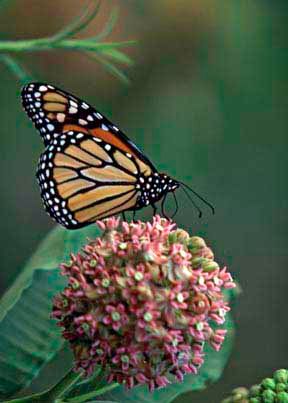
Photos by M. Moryc Copyright 2008, Used by permission.
Why should you consider creating a habitat for Monarch Butterflies? Monarch butterflies are losing their summer habitats as open spaces in North America are being developed. As land is developed, milkweed is killed. Plants in the milkweed family are the only plants that the Monarch caterpillar can eat. Milkweed is also vulnerable to herbicides used by farmers, homeowners, landscapers, and gardeners.
How to create a habitat to attract Monarch butterflies to your backyard or school:
1. You need nectar plants for adult butterflies. Select flowers with vibrant colors and strong fragrances. Suggestions: milkweed family plants, Purple Cone Flowers, Meadow Blazing Star, Zinnias, Coreopsis, all varieties of Aster, Lavender, Bergamot, Joe Pye Weed, Black-eyed Susan, Goldenrod, Bee Balm, and Butterfly Bush.
2. You need plants for the larvae (caterpillars) too! Monarch butterflies will lay their eggs on plants in the milkweed family only because it is the only plant the larvae eat. Plants in the milkweed family are Common Milkweed, Swamp Milkweed, Butterfly Weed, Whorled Milkweed, Bloodweed, and Tropical Milkweed. Often different varieties of milkweed have varying bloom times. So, if you try to include multiple varieties, it helps prolong the time frame that you will have blooms.
3. Sun is essential for a butterfly garden. Try to locate your garden where it will receive at least six hours of direct sunlight each day. Furnish your butterfly garden with flat rocks that will warm up in the sun. Try to place them in the garden where the sunlight will reach the ground early in the day. Butterflies will use these as basking perches.
4. Provide a little water and shelter. Butterflies like wet sand or mud puddles in shady nooks. A few small bushes can provide a shelter where they can roost at night or hide from predators. Dense plantings, with tall and short plants, help with the wind, too, and also give butterflies shelter from predators.
5. Do not use pesticides! Most garden insecticides are lethal to caterpillars. Simply coming into contact with surfaces tainted by insecticide also can kill adult butterflies.
ABOUT MONARCH BUTTERFLIES
The picture below is of the first generation of Monarch caterpillars in the backyard butterfly habitat that I created. These hungry fellows are eating the leaves of Butterfly Weed. Monarchs will lay their eggs on plants in the milkweed family only because it is the only plant the larvae (caterpillars) eat. 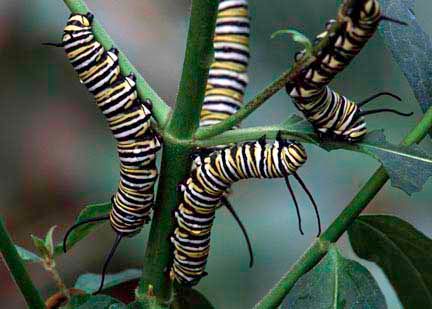
Once the caterpillar is ready to make a chrysalis, it will attach the hind end with silk, hang upside down and make a "J" shape.
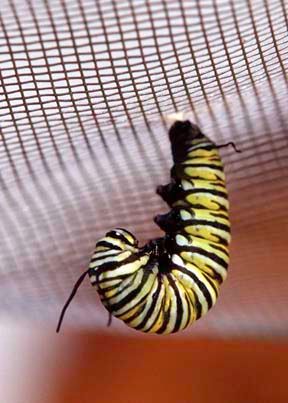
The caterpillar jiggles its body and the skin splits. It jiggles the skin off. As the skin comes off, you can see the light green flesh which turns into the chrysalis.
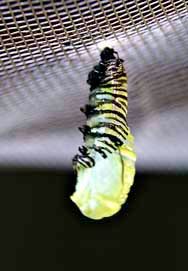
Butterflies do not make cocoons! (click here).
The Monarch chrysalis is dotted with gold trim. It takes about 10-14 days before a butterfly will come out.

What clue can you see that the butterfly is ready to come out of the chrysalis?

One joyous Sunday morning we ate our breakfast outside and watched for about 3 hours as our butterflies came out. This butterfly is pushing the chrysalis open. When butterflies come out of the chrysalis, the body is fat and the wings are folded. The butterfly pumps the fluid out of its plump body into the wings.

The butterfly must dry its wings before it can fly.
This beautiful butterfly is almost ready to fly!

Photos by M. Moryc Copyright 2008 (Used by permission.)
HOME ABOUT MUSIC
PROGRAMS TV SHOW
RADIO SHOW CALENDAR
PRESS KIT CONTACT BLOG
Sign up for monthly newsletter
CONNECT SOCIAL MEDIA
(615) 646-3220
Nashville, Tennessee